
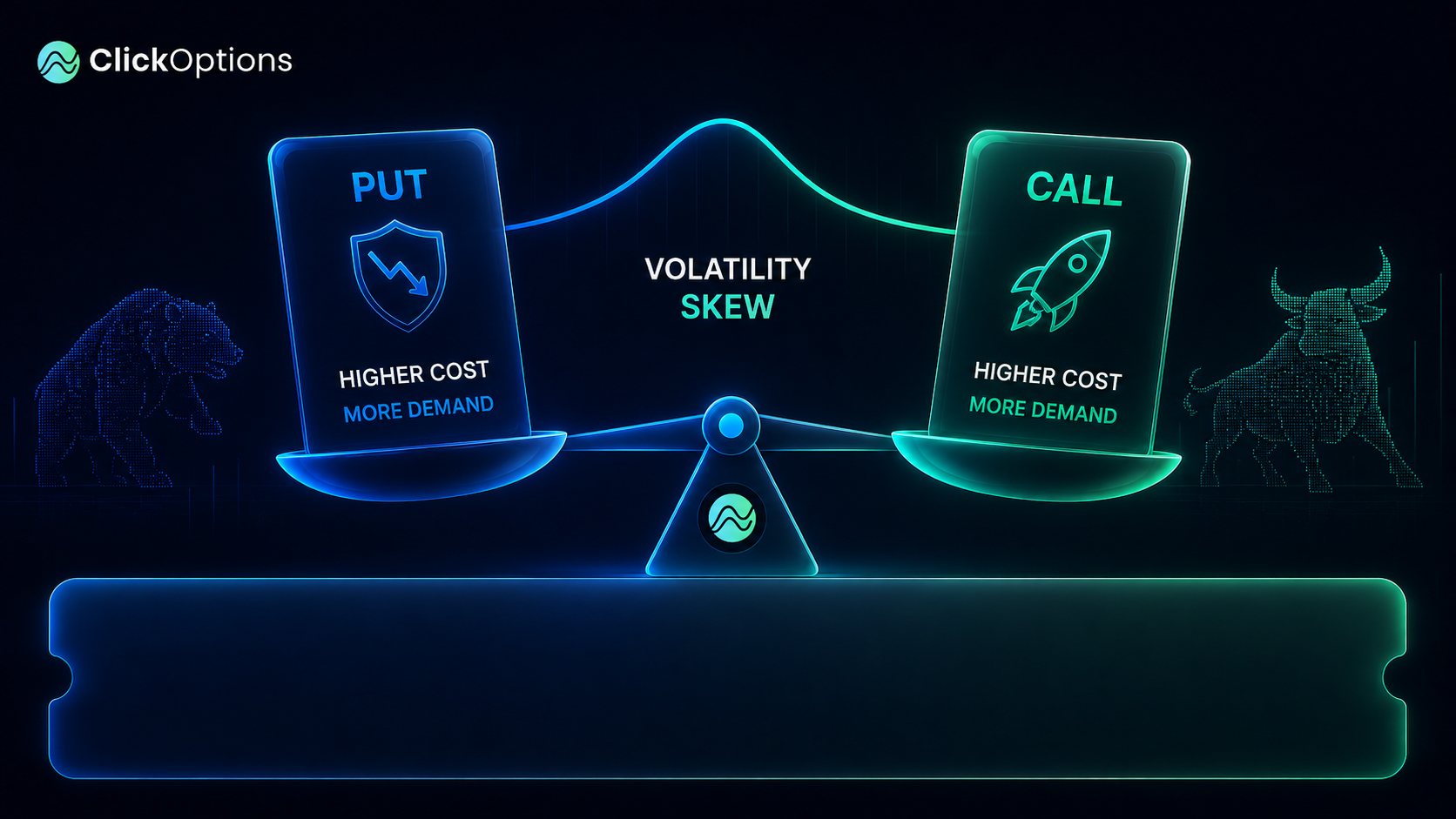
Not every crypto option is priced the same way.
Many traders think option prices are based only on three things: the asset, the direction, and the expiry. For example, they may assume a Bitcoin call and a Bitcoin put should cost roughly the same if both are the same distance from the current price.
In reality, they often do not.
One side of the market can become more expensive than the other. Sometimes traders pay more for downside protection. Other times, they pay more for upside exposure during a strong rally.
This difference is called volatility skew.
For ClickOptions users, understanding skew can make a big difference. It helps traders look beyond simply being bullish or bearish and start asking a better question:
Is this outcome already expensive because many traders are chasing the same side?
What Volatility Skew Means
Volatility skew shows how implied volatility changes across different strike prices or outcomes.
In simple terms, it helps explain why one option may cost more than another even when both seem similar.
For example, if Bitcoin is trading near $100,000, a trader may compare:
- a call option based on Bitcoin moving higher;
- a put option based on Bitcoin moving lower.
If the market is more worried about a downside move, puts may become more expensive. If the market is excited about a strong rally, calls may become more expensive.
Tastylive explains that negative skew often appears when out-of-the-money puts have higher implied volatility than calls, showing greater demand for downside protection. Positive skew can appear when out-of-the-money calls become more expensive, showing stronger demand for upside exposure. (tastylive.com)
The key point is simple: skew shows where traders are willing to pay more.
Why Downside Protection Can Become Expensive
In many markets, traders often pay more for protection against sharp drops.
This is common in traditional stock markets, where investors may buy puts to hedge portfolios. When fear rises, downside protection becomes more valuable. That extra demand can make puts more expensive.
Crypto can behave the same way.
If Bitcoin or Ethereum starts falling quickly, traders may rush to protect against more downside. This can push up the price of bearish options and make downside outcomes more expensive to trade.
For ClickOptions users, this matters because a bearish trade may look attractive after a market drop, but the price may already reflect fear. If many traders are paying for the same downside scenario, the payout may be less attractive than it first appears.
A trade can be logical and still be expensive.
Why Upside Calls Can Also Become Expensive
Crypto is different from many traditional markets because upside excitement can also become extreme.
When Bitcoin or Ethereum breaks higher, traders may rush into bullish positions. The market starts pricing in the possibility of a bigger rally. As demand for upside exposure increases, call options or bullish outcomes can become more expensive.
This is often seen during momentum phases.
Traders may not want to miss the next breakout. They may chase calls, upside targets, or prediction-style outcomes linked to higher prices. That demand can shift the skew toward the upside.
On ClickOptions, this is important because a bullish outcome may look popular for a reason. But popularity can also mean the opportunity has already become expensive.
If one side of the market looks obvious, traders should ask whether that view is already priced in.
How Skew Reflects Trader Sentiment
Volatility skew is not just a pricing detail.
It can also be a sentiment signal.
If downside options are more expensive, the market may be nervous. If upside options are more expensive, the market may be chasing a rally. If pricing is more balanced, sentiment may be less one-sided.
Crypto-options analytics providers increasingly focus on volatility surfaces, skew, and term structure because these metrics help traders understand how markets are pricing risk across different strikes and expiries. Block Scholes noted that its crypto volatility data integration helps institutions monitor volatility surfaces and compare skew and term structure across BTC and ETH options. (blockscholes.com)
This is useful for ClickOptions users because the platform is built around clear outcomes and options-style trades. Even when the trade setup is simple, the pricing may still reveal what the market is worried about or excited about.
Why Crypto Skew Can Change Quickly
Crypto markets move fast.
A single headline can change sentiment. ETF flows, liquidation events, regulation news, macro data, exchange outages, large wallet movement, or sudden volatility can all shift pricing.
This means skew can change quickly.
A market that was paying more for upside exposure in the morning may start paying more for downside protection after a sharp selloff. A calm market can become nervous. A bearish market can turn into a squeeze higher.
CME has highlighted how Bitcoin options activity and volatility can spike during sharp market stress, especially when traders migrate toward options during selloffs. (cmegroup.com)
For ClickOptions traders, this is why checking the price of the outcome matters before every trade. Yesterday’s pricing may not reflect today’s market.
Why ClickOptions Traders Should Compare Outcomes
On ClickOptions, traders should not only ask whether they are bullish or bearish.
They should compare how different outcomes are priced.
If the bullish side is much more expensive, it may mean traders are already paying heavily for upside. If the bearish side is much more expensive, it may mean fear is already priced in. If one outcome has a lower payout than expected, it may be because the market sees that outcome as more likely.
ClickOptions positions itself around clearer crypto options trading, including transparent risk and weekly spread benchmarks. Its public profile describes the platform as focused on tighter quotes, deeper liquidity across strikes and expiries, and clearer risk for crypto options traders. (linkedin.com)
That type of clarity is useful, but the trader still needs to think.
A clear trade setup does not automatically mean the trade is attractive. The trader should still compare the premium, payout, expiry, condition, and market context.
A Simple Example
Imagine Bitcoin has rallied sharply for several days.
Many traders now expect more upside. Bullish calls and upside prediction outcomes may become more expensive because demand is high.
A trader may still believe Bitcoin can move higher. But if the upside trade is already expensive, the market may require a stronger move for the trade to pay well.
Now imagine the opposite.
Bitcoin suddenly drops after negative news. Traders rush to protect against more downside. Bearish options become more expensive. A trader may believe further downside is likely, but the price of that bearish outcome may already reflect panic.
This is skew in action.
The question is not only, “Which direction do I believe?”
The better question is, “How much am I paying for that direction?”
Final Thought
Volatility skew helps explain why some crypto options cost more than others.
It shows where traders are paying for protection, where they are chasing upside, and how market sentiment is being priced into options.
For ClickOptions users, skew is especially important because the platform focuses on options and prediction-style outcomes. The trade may be easy to understand, but the pricing still matters.
Before entering a trade, traders should compare both sides of the market, review the expiry, understand the maximum risk, and ask whether the outcome is already expensive.
The better question is not only, “Am I bullish or bearish?”
It is:
“Is the market already charging too much for the outcome I want to trade?”