

As with any trade, it is critical to know your absolute best-case and worst-case scenarios before you ever risk a single dollar.
In this article, we are going to break down exactly how to calculate the maximum profit and the maximum loss for both the buyer and the seller of a "Right to Buy" ticket.
To keep things perfectly simple, we are going to rely on the ClickOptions standard: 1 ticket always equals 1 Bitcoin.
Step 1: Finding the "Raw" Ticket Value
Before we can figure out how much money went into your pocket, we need to know what the ticket itself is worth at the deadline.
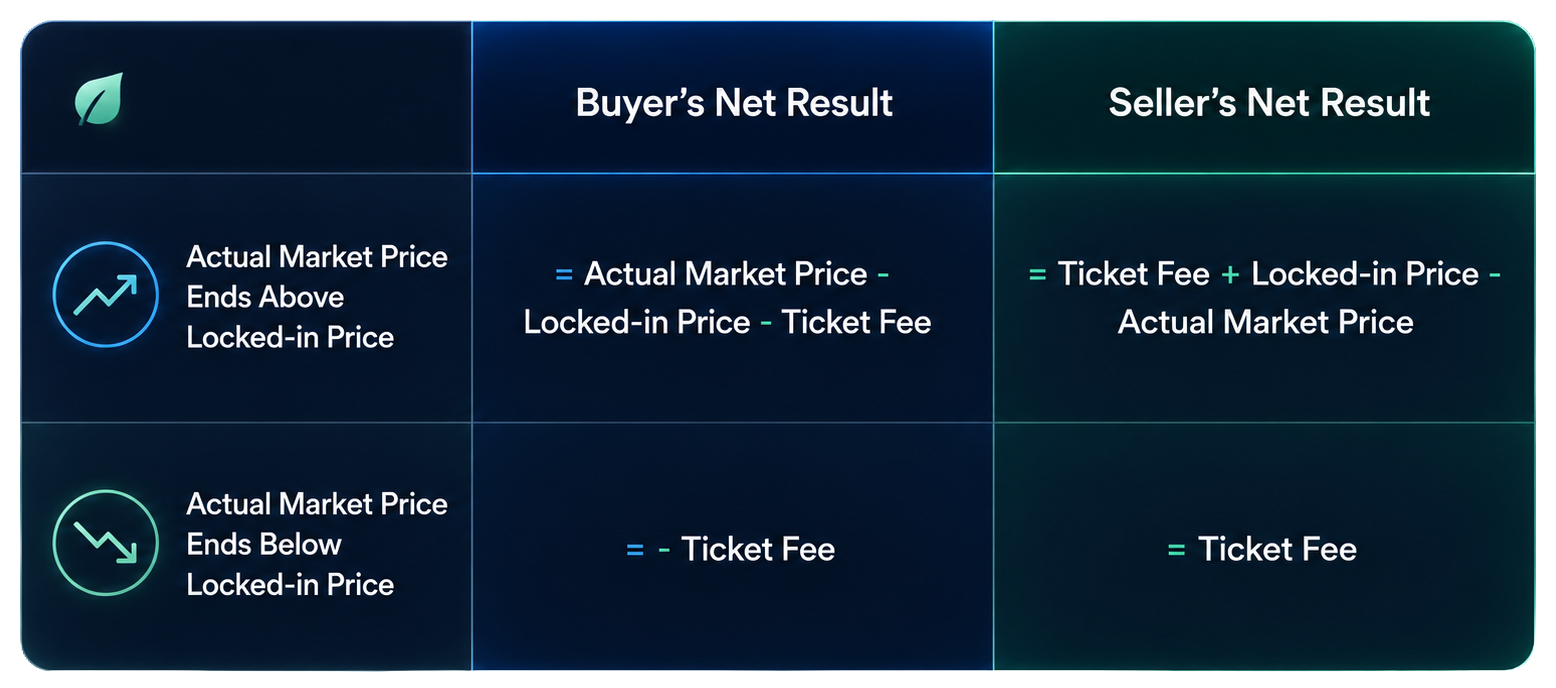
If Bitcoin's actual market price ends up higher than your locked-in target price, your ticket has value. To find that value, you simply subtract your target price from the current market price: Raw Ticket Value = Actual Market Price – Locked-in Price
Step 2: Calculating the Buyer's Final Result
To find the buyer's true profit, we just take that Raw Ticket Value and subtract the upfront fee they paid to get into the trade. Buyer’s Net Result = Raw Ticket Value – Ticket Fee
If we substitute our first formula into this one, we get the master formula for a winning buyer: Buyer’s Net Result = Actual Market Price – Locked-in Price – Ticket Fee
Step 3: Calculating the Seller's Final Result
Because trading is a perfect mirror, the seller's math is simply the exact opposite of the buyer's math. The seller collects the fee, but loses the raw ticket value. Seller’s Net Result = Ticket Fee – Raw Ticket Value
If we expand that, the master formula for a losing seller looks like this: Seller’s Net Result = Ticket Fee + Locked-in Price – Actual Market Price
(Note: If the actual market price is below the locked-in price at the deadline, the ticket is worthless. The buyer's net result is simply a loss of their ticket fee. The seller's net result is simply a profit of that exact same fee).
A Real-World Number Example
Let's plug some real numbers into this logic so you can see it in action.
Assume a trader buys a ticket locking in their right to buy Bitcoin at $50,000. The fee for this ticket is $4,000. At the deadline, the actual price of Bitcoin has skyrocketed to $70,000.
Because $70,000 is higher than our $50,000 target, the ticket is highly valuable. Let's run the master formulas:
The Buyer’s Profit:
- Actual Market Price ($70,000) – Locked-in Price ($50,000) – Ticket Fee ($4,000)
- $70,000 - $50,000 - $4,000 = $16,000
- The buyer walks away with a pure profit of $16,000.
The Seller’s Loss:
- Ticket Fee ($4,000) + Locked-in Price ($50,000) – Actual Market Price ($70,000)
- $4,000 + $50,000 - $70,000 = -$16,000
- The seller suffers a massive loss of $16,000.
Understanding Your Absolute Limits
Beyond calculating specific numbers, you must understand the absolute limits of your trade.
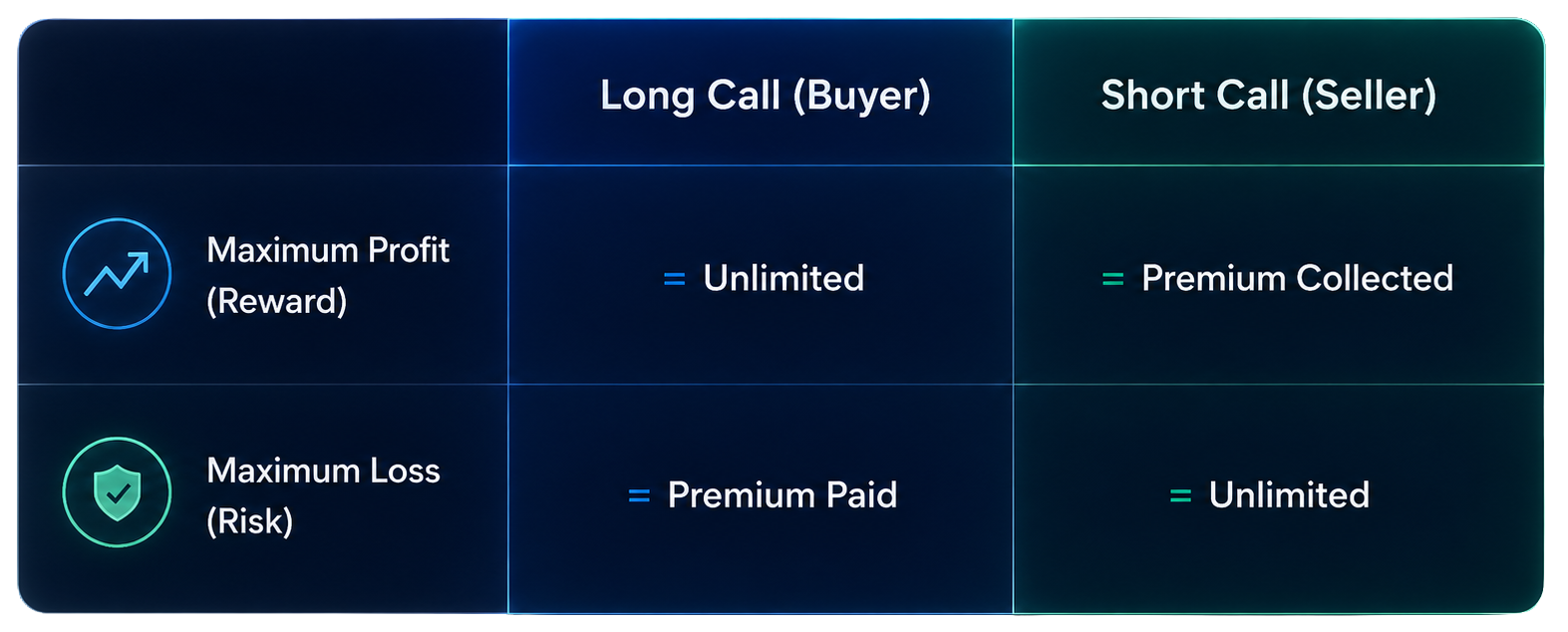
For the Buyer: For every dollar Bitcoin increases, the buyer makes another dollar. Because there is theoretically no limit to how high an asset's price can go, the buyer's maximum profit is unlimited. However, their worst-case scenario is strictly capped. If the market crashes, the absolute maximum the buyer can ever lose is the small ticket fee they paid upfront.
For the Seller: When the buyer makes their maximum profit, the seller takes their maximum loss. For every dollar the market rises, the seller owes the buyer another dollar. Therefore, the seller's maximum loss is unlimited. Their best-case scenario is heavily capped. If the market crashes, the absolute maximum the seller can ever make is the small ticket fee they collected upfront.
In Summary
- The Buyer: Enjoys strictly fixed risk, but has the potential for unlimited profit.
- The Seller: Enjoys a fixed, capped profit, but takes on the potential for unlimited risk.
While these calculations are easy to do in your head on ClickOptions, it is vital to always know whether you are stepping into a trade with fixed risk or unlimited risk. This core principle will protect your capital as you grow into a seasoned trader.