
Options trading is moving beyond the normal market day.
For years, U.S. stock options were mostly tied to regular trading hours. Traders could watch futures, crypto, foreign markets, earnings reactions, and overnight news, but they usually had to wait for the opening bell to trade many equity options.
That is starting to change.
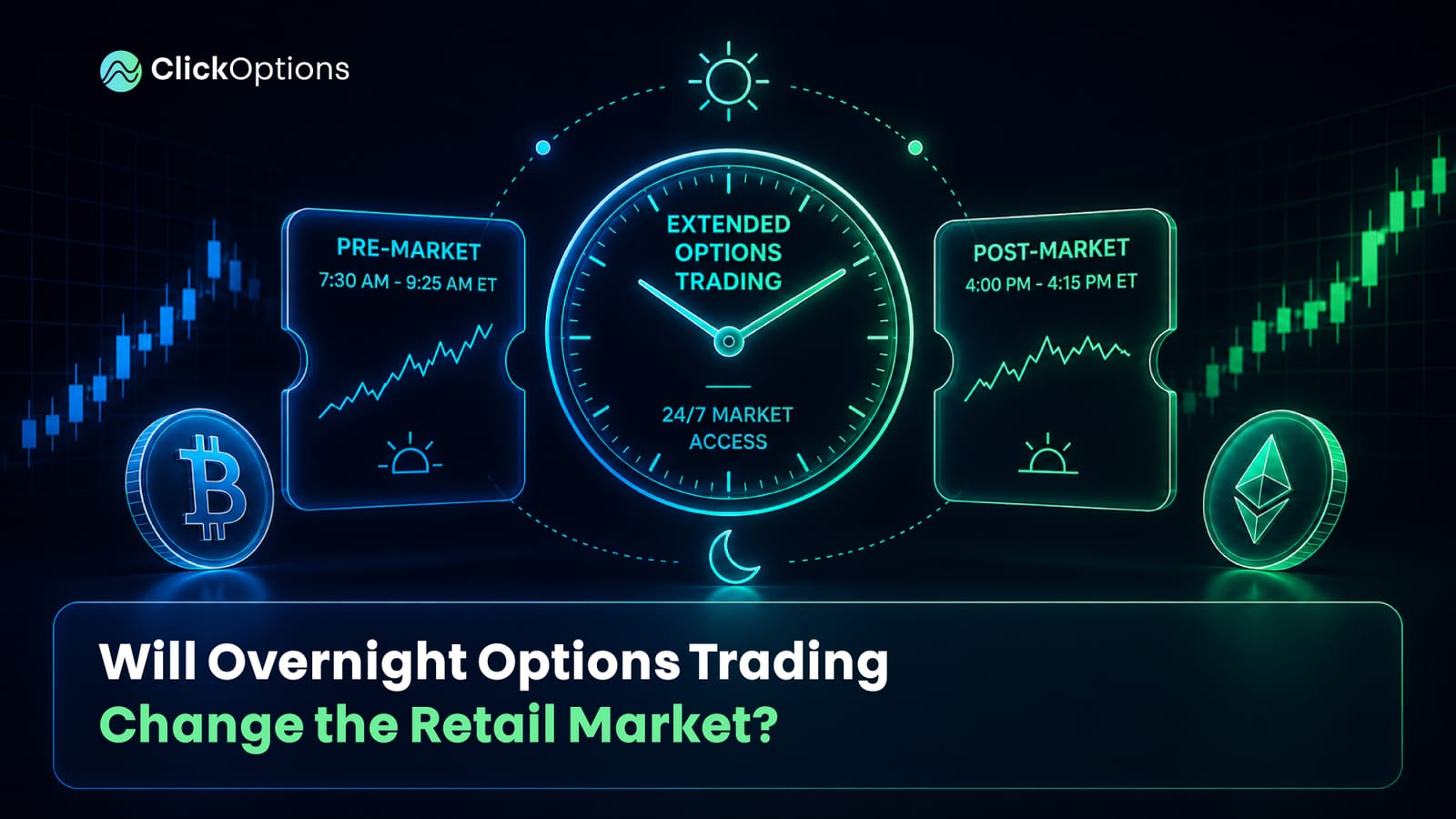
Cboe received SEC approval to offer extended trading hours for select multi-listed equity options. Cboe Options Exchange plans to begin offering the extended sessions on July 13, 2026, subject to SEC approval of a related rule filing. The new sessions are expected to include a pre-market window from 7:30 a.m. ET to 9:25 a.m. ET and a short post-market window from 4:00 p.m. ET to 4:15 p.m. ET, Monday through Friday.
This may not sound like a huge change at first. But for retail options traders, it matters.
Markets do not wait for 9:30 a.m. anymore. Earnings can move stocks after the close. Inflation data can hit before the open. Global news can change sentiment overnight. Crypto can move sharply while U.S. equity markets are closed.
Extended-hours options trading gives traders more access to react. It also gives them more ways to make mistakes.
What Extended-Hours Options Trading Means
Extended-hours options trading means certain options can be traded before or after the standard U.S. market session.
The regular U.S. stock market session runs from 9:30 a.m. ET to 4:00 p.m. ET. Under Cboe’s plan, select multi-listed equity options would also trade during a pre-market session and a brief post-market session.
At launch, the focus is expected to be on some of the most actively traded and liquid names. Reports around the approval noted that roughly 20 names may be available at launch, including major stocks such as Nvidia, Tesla, Apple, and other highly active names.
That makes sense.
Extended-hours options trading is most likely to work where there is strong demand, active underlying stock trading, and enough liquidity to support a functioning market.
Why Traders Want Access Outside Regular Market Hours
Retail traders already think outside regular market hours.
They watch pre-market movers. They react to earnings reports after the close. They follow crypto on weekends. They track Asia and Europe before the U.S. session begins. They check futures before the opening bell.
The problem is that traditional options access has not always matched that behavior.
If Nvidia reports earnings after the close and the stock moves sharply, a trader may want to adjust an options position immediately. If inflation data comes out before the open, a trader may want to hedge or react before regular trading begins. If global news changes market sentiment overnight, waiting until 9:30 a.m. can feel late.
Extended-hours options trading gives traders more flexibility.
But flexibility is not the same as safety.
Earnings, Global News, and Overnight Sentiment
Some of the biggest market moves happen outside regular hours.
Earnings reports are a clear example. A stock can move 5%, 10%, or more after results are released. Guidance, margins, revenue growth, and management commentary can all change the next day’s expectations before the regular session begins.
Macro events also matter. Inflation reports, jobs data, Federal Reserve commentary, geopolitical news, and global market moves can all shift sentiment before U.S. traders reach the opening bell.
Crypto adds another layer.
Bitcoin, Ethereum, and digital asset markets trade around the clock. A major move in crypto can affect sentiment in crypto-related stocks, risk assets, and options-style products before traditional markets open.
This is where platforms such as ClickOptions fit into the broader trend. ClickOptions is built around options and prediction options, giving traders a focused way to take views on digital asset outcomes and market direction. As traders become more comfortable reacting outside traditional market hours, platforms that support flexible, outcome-based trading may become more relevant.
More Access Can Mean More Risk
The main benefit of extended-hours options trading is access.
The main risk is also access.
When traders can trade more often, they may feel pressure to trade more often. That can lead to overtrading, emotional entries, poor exits, and unnecessary risk.
More access does not automatically improve decision-making. It simply creates more opportunities to make decisions.
That matters because options already move quickly. During extended hours, conditions may be even more difficult. Liquidity may be thinner. Spreads may be wider. Price discovery may be less stable. A trader who rushes into a position before the market fully opens may get a poor fill or misunderstand the true value of the contract.
The ability to react faster is useful only if the trader reacts with discipline.
Liquidity May Be Thinner Overnight
Liquidity is one of the biggest questions around extended-hours options trading.
During regular market hours, heavily traded options often have tighter markets, more participants, and better price discovery. Outside regular hours, there may be fewer buyers and sellers.
That can create problems.
If fewer participants are quoting options, bid-ask spreads can widen. A trader may have to pay more to enter or accept less to exit. Slippage can become more noticeable. A trade that looks good on a chart may become less attractive once execution costs are included.
This is especially important for retail traders who focus only on direction.
Being right about a move is not enough if the entry price is poor. A wide spread can quietly reduce the potential reward before the trade even starts.
Why Bid-Ask Spreads Matter More After Hours
The bid-ask spread is the difference between what buyers are willing to pay and what sellers are asking.
In liquid markets, that spread may be tight. In thinner markets, it can become wide.
For options, spreads matter a lot because option prices can already be sensitive to time, volatility, and movement in the underlying stock. Add a wide spread, and the trader may start the position at an immediate disadvantage.
This is why extended-hours options trading should not be treated like regular-hours trading with a different clock.
The market structure may feel different. The prices may move differently. The fills may be worse. The visible quote may not always reflect the price a trader expects.
Before trading outside normal hours, traders should pay close attention to limit orders, bid-ask spreads, contract volume, open interest, and execution quality.
How Platforms May Compete
Extended-hours options trading could create a new area of competition between platforms.
Retail traders may start comparing platforms not only by commissions and interface, but also by access, execution, risk tools, alerts, education, and after-hours functionality.
Platforms that can show clear pricing, strong risk visibility, and better trade controls may stand out.
This applies to traditional options platforms such as thinkorswim, tastytrade, Interactive Brokers, Robinhood, and Webull. It also applies to specialist platforms such as ClickOptions, where traders may be looking for simpler ways to express options-style views on digital asset markets and prediction-based outcomes.
The next phase of platform competition may not only be about who offers more products.
It may be about who helps traders understand those products before they trade them.
The Risk of Treating Markets Like They Are Always Open
One danger of extended access is the feeling that traders always need to be active.
If markets are open earlier, traders may wake up and feel pressure to trade. If options are available after the close, traders may feel the need to react immediately to earnings. If crypto moves overnight, traders may feel they are missing something.
That mindset can be dangerous.
Good trading does not require constant action. It requires a plan.
A trader who enters a position at 8:00 a.m. because of a headline may not have enough information. A trader who reacts to an earnings move after the close may be trading into poor liquidity. A trader who constantly watches overnight markets may become more emotional, not more prepared.
More access should not mean less patience.
What Retail Traders Should Understand First
Before using extended-hours options trading, retail traders should understand the basic risks.
They should know:
- which contracts are eligible for extended-hours trading;
- whether their broker supports access;
- how liquidity changes outside regular hours;
- how bid-ask spreads affect execution;
- whether limit orders are required or recommended;
- how earnings and news can affect volatility;
- how much capital is at risk;
- what their exit plan is before entering the trade.
This is especially important for short-dated options.
A same-day or near-expiration option can move quickly during normal hours. In extended hours, the risks around pricing, spreads, and liquidity may be even more important.
Where ClickOptions Fits Into the Bigger Picture
The move toward extended-hours options trading is part of a broader market shift.
Traders want more flexibility. They want faster access. They want products that match how modern markets actually move. That includes traditional options, crypto options, prediction options, and outcome-based trading products.
ClickOptions fits into this broader demand for flexible trading access. As traders look beyond traditional market hours and traditional products, options and prediction options platforms may become more relevant for users who want focused ways to trade digital asset outcomes and market direction.
The key point is not that every trader needs more access.
The key point is that more access should come with better understanding.
Whether a trader is using traditional stock options, extended-hours options, crypto options, or prediction options, the same question matters:
Do I understand the risk before I place the trade?
More Access Should Come With More Discipline
Extended-hours options trading could help traders manage risk more actively.
A trader may be able to adjust a position after earnings. A trader may be able to respond to pre-market news. A trader may be able to avoid waiting until the open, when prices can gap sharply.
But the same access can also encourage bad habits.
Overtrading, chasing headlines, ignoring spreads, and reacting emotionally can all become bigger problems when the trading window expands.
A disciplined trader should still have rules:
- use limit orders;
- avoid oversized positions;
- check spreads before entering;
- know the maximum loss;
- avoid trading only because the market is open;
- be careful around earnings and major news;
- review trades after the session;
- understand platform-specific rules.
The goal is not to trade at every available hour.
The goal is to trade only when the setup makes sense.
Final Thought
Extended-hours options trading could change how retail traders interact with the market.
It gives traders more flexibility to react to earnings, pre-market data, global news, and overnight sentiment. It may also push platforms to compete on access, speed, education, and risk tools.
But more access does not remove the hard parts of options trading.
Liquidity may be thinner. Spreads may be wider. Slippage may matter more. Emotional trading may become easier. Traders may feel pressured to act when patience would be better.
Platforms such as Cboe are expanding when certain options can trade. Platforms such as ClickOptions show how the broader market is also moving toward more flexible options and prediction options experiences.
The future of trading may offer more access than ever.
The better question is not, “Can I trade outside regular hours?”
The better question is, “Should I trade this setup, at this price, with this level of risk?”