
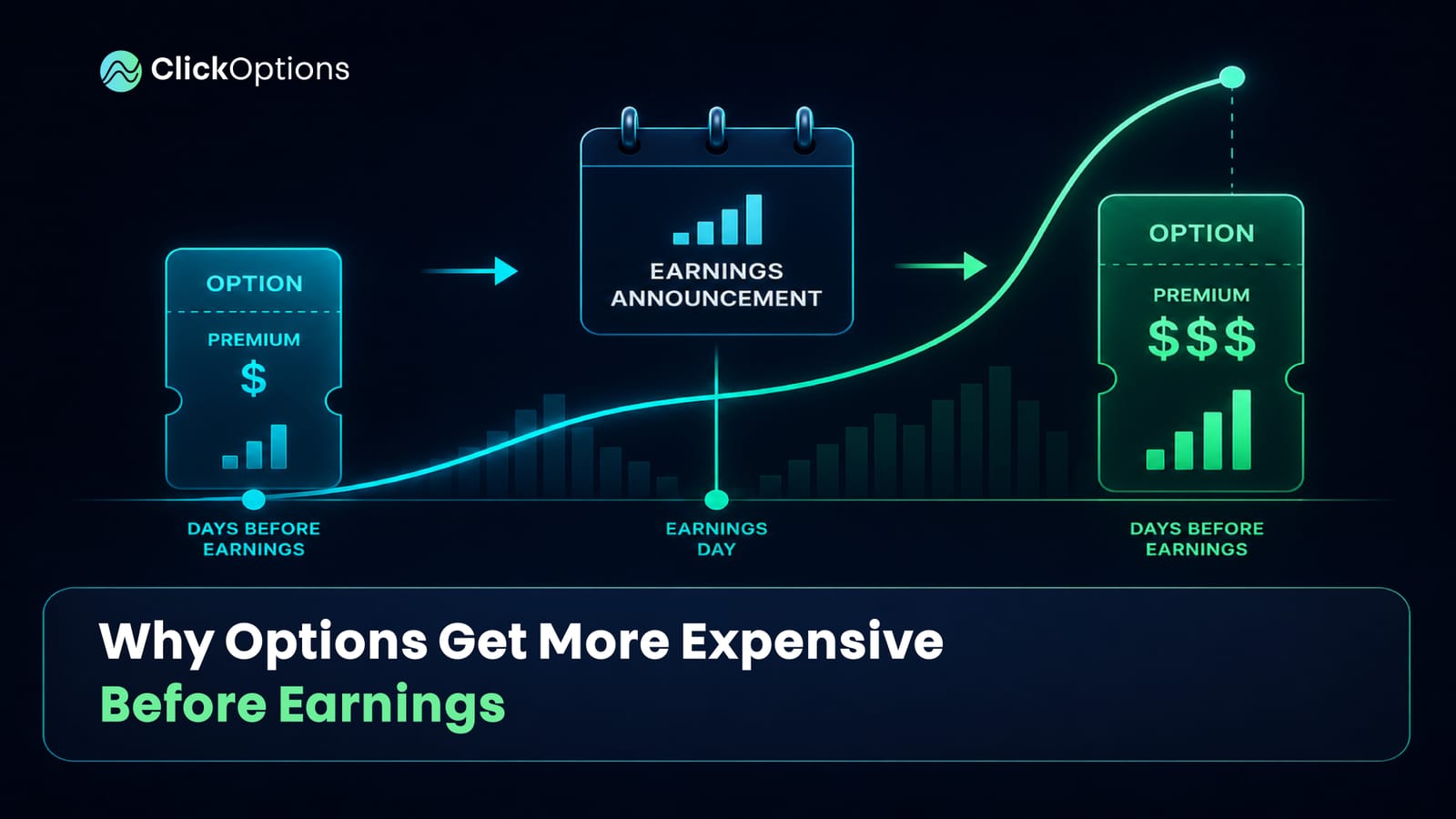
Earnings season is one of the busiest periods for options traders.
Before a company reports earnings, traders often expect the stock to move sharply. The move may be up or down, but the expectation of movement alone can make options more expensive.
This is why a call or put option may look unusually costly before earnings. The market is not only pricing the current stock price. It is also pricing uncertainty.
That uncertainty shows up through implied volatility, often called IV.
For options traders, understanding implied volatility before earnings is essential. A trader can be right about the direction of a stock and still lose money if the option was too expensive at entry or if implied volatility falls after the announcement.
That post-earnings drop in volatility is commonly known as IV crush.
What Happens Before Earnings?
Earnings reports can change how investors value a company.
A single report can reveal stronger revenue, weaker profit margins, better guidance, slowing demand, higher costs, or changes in management’s outlook. For large companies, earnings can also affect an entire sector.
That uncertainty matters to the options market.
Before earnings, buyers may be willing to pay more for calls and puts because they expect a bigger move. Sellers may demand more premium because they are taking on more event risk. As a result, options premiums often rise ahead of the announcement.
Implied volatility reflects the market’s expectation of future movement, not the direction of that movement. In other words, high implied volatility does not mean the market expects the stock to go up. It means the market expects the stock to move more than usual.
What Is Implied Volatility?
Implied volatility is one of the most important concepts in options trading.
It represents the market’s estimate of how much an underlying asset may move over a specific period. When implied volatility rises, options usually become more expensive. When implied volatility falls, options usually become cheaper.
This affects both calls and puts.
For example, if Nvidia is about to report earnings, traders may expect a large move. Some traders may buy calls because they expect the stock to rise. Others may buy puts because they expect the stock to fall. This demand can push options premiums higher on both sides.
Reuters reported that options markets were pricing a roughly 6.5% move in Nvidia shares around its May 2026 earnings, equal to a potential market value swing of about $355 billion.
That is the power of earnings expectations. The option price is not just about where the stock is today. It is about how far the market thinks the stock could move after the report.
Why Options Can Be Expensive Even When the Stock Hasn’t Moved
Many beginners are confused when they see options become more expensive before earnings even though the stock price has barely changed.
The reason is that options price in more than direction.
An option’s price is affected by several factors, including:
- the current stock price;
- the strike price;
- time until expiration;
- implied volatility;
- interest rates;
- dividends;
- liquidity and bid-ask spreads.
Before earnings, implied volatility often becomes the key factor.
If the market expects a large move, options sellers take on more risk. They may require higher premiums to compensate for that risk. Buyers, meanwhile, may be willing to pay more because they believe the earnings move could be large enough to justify the cost.
This creates a situation where both calls and puts can become expensive at the same time.
What Is IV Crush?
IV crush happens when implied volatility drops sharply after a major event passes.
Before earnings, uncertainty is high. After earnings are released, the uncertainty is reduced. The company has reported the numbers. Guidance is known. The market reacts. Once that uncertainty is gone, the extra volatility premium can disappear quickly.
Schaeffer’s Research explains that volatility crush often occurs after scheduled events such as earnings, because the uncertainty premium priced into options before the event drops out after the news is released.
This is why traders can lose money even when they guess the direction correctly.
Imagine a trader buys a call option before earnings because they expect the stock to rise. The stock does rise after the report, but not by enough. If implied volatility collapses after earnings, the option may lose value despite the stock moving in the right direction.
That is one of the most important lessons in earnings options trading: being right about direction is not always enough.
Why Earnings Options Are Risky for Beginners
Earnings trades are tempting because the potential moves can be large.
A stock can jump 10%, fall 15%, or gap sharply overnight after reporting results. For traders holding options, those moves can create large gains or fast losses.
The risk is that many beginners only focus on direction.
They ask, “Will the stock go up or down?”
A better question is, “Is the option price already reflecting the expected move?”
If the market expects a 7% move and the stock moves 3%, an options buyer may still lose money. If implied volatility falls sharply after the report, that loss can happen quickly.
This is why earnings options are often more complicated than they look. Traders need to understand both the expected move and the price they are paying for exposure.
The Expected Move Matters
Before earnings, options prices can be used to estimate how much the market expects a stock to move.
This is often called the expected move.
The expected move does not predict direction. It gives traders a rough idea of how much movement is already priced into the options market.
For example, if options imply a 6% move after earnings, a trader buying calls may need the stock to move more than expected to make a strong profit. A small move in the right direction may not be enough.
This is why some traders avoid buying expensive options before earnings unless they believe the market is underpricing the potential move.
Others may use defined-risk spreads to limit exposure or structure trades around volatility rather than pure direction.
Why Defined-Risk Strategies Matter
Earnings are unpredictable. Even strong companies can fall after good results if expectations were too high. Weak companies can rise if results are better than feared.
Because of that uncertainty, defined-risk strategies can be useful for education and risk control.
A defined-risk strategy sets the maximum possible loss before the trade is placed. Examples include debit spreads, credit spreads, iron condors, and certain calendar or diagonal structures.
These strategies are not risk-free. They can still lose money. But they can help traders avoid open-ended exposure and understand the trade’s risk before entering.
Investor’s Business Daily recently discussed an advanced Broadcom options setup ahead of earnings, noting elevated near-term volatility and emphasizing defined risk and careful trade management.
For newer traders, the lesson is not to copy any specific strategy. The lesson is to understand risk before entering an earnings trade.
Where Platforms and Tools Fit In
Modern options platforms are making it easier for traders to analyze earnings setups.
Platforms such as thinkorswim, tastytrade, Interactive Brokers, Robinhood, and Webull provide options chains, pricing data, risk graphs, implied volatility readings, and educational resources. Some platforms also include paper trading, probability tools, and strategy builders.
These tools can help traders estimate risk before placing a trade.
Specialist platforms such as ClickOptions also fit into the broader trend of simplifying options-style trading experiences. ClickOptions focuses on options and prediction options, showing how newer platforms are building around clearer trade structures, simplified access, and outcome-based market views.
The important point is that tools should support understanding. They should not replace it.
A clean interface can make an options trade feel simple, but earnings risk, volatility risk, and timing risk still matter.
The Same Lesson Applies Beyond Stock Earnings
The earnings example is useful because it shows how uncertainty affects option prices.
But the same idea applies beyond stocks.
Options can become more expensive before major events in crypto, indexes, ETFs, commodities, interest rates, or economic data. Whenever the market expects a larger move, implied volatility can rise. After the event passes, implied volatility may fall.
For traders using platforms such as ClickOptions, the same principle matters in crypto options and prediction options. If a product is tied to a specific market outcome, traders still need to understand the price they are paying, the probability of the outcome, the potential reward, and the maximum risk.
Whether the underlying market is Nvidia, Tesla, Bitcoin, Ethereum, SPX, or a prediction-based setup, the core lesson is the same: uncertainty has a price.
How Traders Can Approach Earnings Options More Carefully
Earnings trades should start with preparation, not excitement.
Before entering a trade, traders should ask:
- What move is already priced in?
- Is implied volatility higher than usual?
- What happens if the stock moves less than expected?
- What happens if I am right about direction but wrong about timing?
- What is my maximum loss?
- Is the bid-ask spread reasonable?
- Am I using a defined-risk structure?
- Am I trading based on a plan or emotion?
Paper trading can also help traders understand how earnings options behave without risking capital. Watching how options prices change before and after a report can be more valuable than rushing into a live trade.
Final Thought
Options become more expensive before earnings because uncertainty increases.
The market knows that earnings can move a stock sharply, so that risk is reflected in option premiums. Traders who buy options before earnings are not just betting on direction. They are also paying for volatility, timing, and the possibility of a larger-than-normal move.
That is why earnings options can be both attractive and dangerous.
A trader may be right about the stock and still lose money if the option was overpriced. A trader may underestimate IV crush and watch a position lose value after the event. A trader may focus on potential gains while ignoring how much risk is already priced into the trade.
The better question is not, “Will the stock go up or down after earnings?”
The better question is, “Is the option priced fairly for the move I expect?”
This article is for educational purposes only and should not be considered financial advice.