
Retail traders are paying more attention to options.
That means they also need to pay more attention to implied volatility.
Many beginners start by asking one simple question: will the stock, ETF, index, or crypto asset go up or down?
That question matters, but it is not enough.
In options trading, direction is only part of the trade. The price of an option is also affected by time, volatility, strike selection, expiration, liquidity, and market expectations. A trader can be right about direction and still lose money if the option was too expensive at entry.
This is where implied volatility becomes important.
Implied volatility helps explain why some options are cheap, why others are expensive, and why option prices can change quickly even when the underlying asset barely moves.
What Is Implied Volatility?
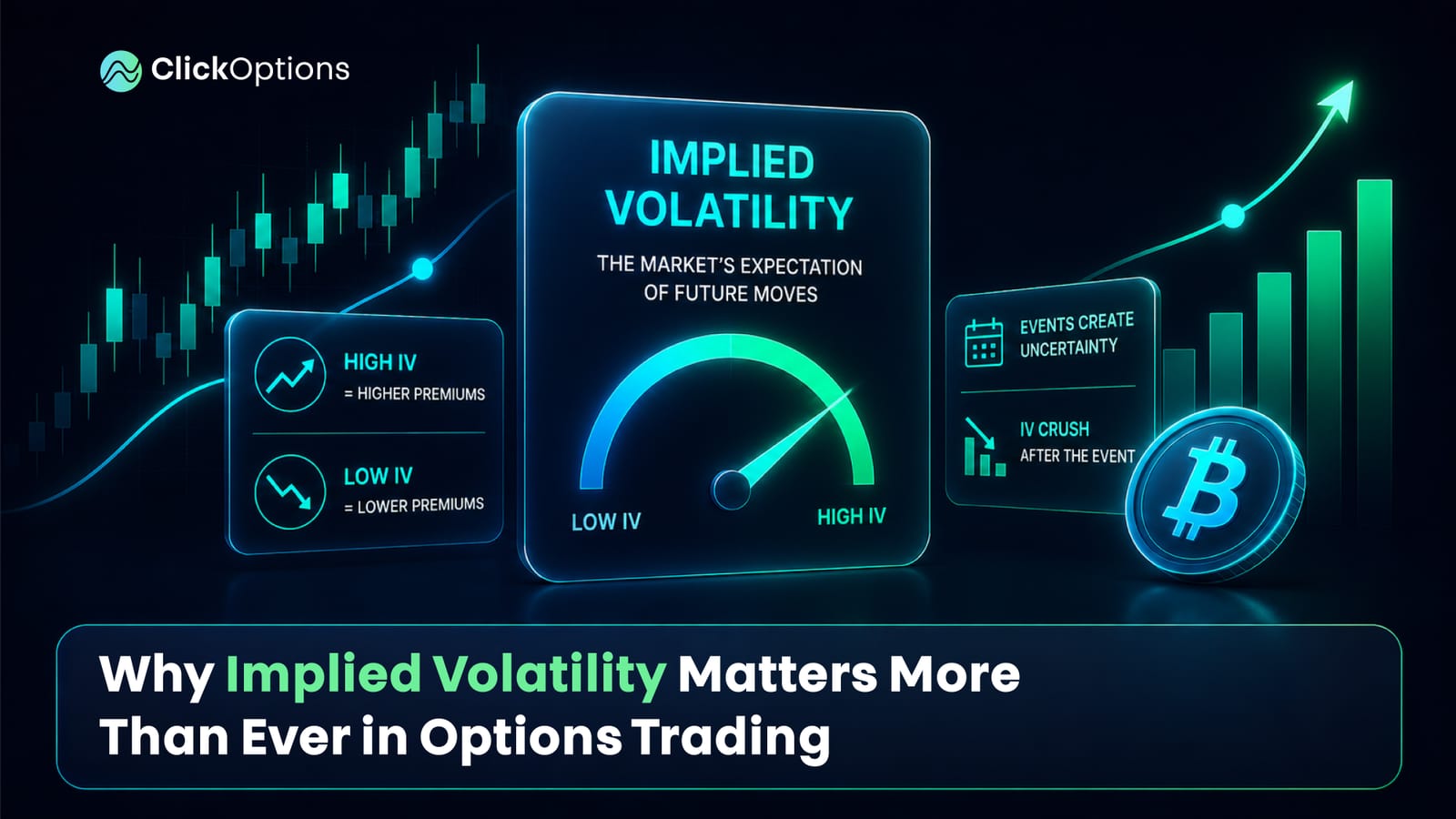
Implied volatility, often called IV, is the market’s expectation of how much an asset may move in the future.
It does not predict direction.
High implied volatility does not mean the market expects a stock to rise. It means the market expects a larger move. That move could be up or down.
Low implied volatility means the market expects a smaller move, or at least less uncertainty than usual.
In simple terms:
Higher IV usually means more expensive options.
Lower IV usually means cheaper options.
That applies to calls and puts.
If traders expect a major move in Nvidia, Tesla, SPX, Bitcoin, or Ethereum, options tied to those assets can become more expensive. If the market expects calm conditions, options may become cheaper.
Why IV Matters More for Retail Traders Now
Options trading is no longer limited to advanced traders.
Retail participation has grown, and options volume remains elevated. Cboe reported that market-wide options average daily volume reached 68.6 million contracts in Q1 2026, compared with 60.4 million contracts in Q1 2025. Index options and ETF options were major drivers of that growth.
As more retail traders use options, more traders need to understand what they are actually buying.
Buying a call is not just a bet that the asset will rise. Buying a put is not just a bet that the asset will fall. The trader is also buying volatility, time, and probability.
That is why IV matters.
If a trader buys an option when implied volatility is already high, the trade may need a larger-than-expected move to become profitable. If implied volatility falls after entry, the option can lose value even if the underlying asset moves in the right direction.
Why Options Get Expensive
Options usually get more expensive when uncertainty rises.
That can happen before earnings, Federal Reserve decisions, inflation reports, crypto market events, product announcements, lawsuits, regulatory news, or major macroeconomic developments.
Before a major event, traders may expect a bigger move. Buyers are willing to pay more for exposure. Sellers demand more premium because they are taking on more risk. That pushes implied volatility higher.
This is why options on popular stocks can become expensive before big moments.
Retail traders often see this in names like Nvidia, Tesla, Apple, Micron, and major ETFs. MarketWatch recently reported that SpaceX-linked options trading saw implied volatility reach as high as 93% after trading began, showing how excitement and uncertainty can quickly raise option premiums.
The same idea applies across markets. When traders expect movement, options prices often rise before the movement actually happens.
Direction Is Not Enough
One of the biggest beginner mistakes is thinking that being right about direction is enough.
It is not.
Imagine a trader buys a call option before earnings because they expect the stock to rise. The stock does rise, but not by much. After earnings, implied volatility falls because the uncertainty is gone. The call option may lose value even though the stock moved higher.
That can feel confusing, but it is normal in options.
The trader was right about direction but wrong about the price of the option.
This is why experienced options traders often ask a different question:
Is the option fairly priced for the move I expect?
That question is more useful than simply asking whether the asset will go up or down.
IV Crush: The Risk Many Beginners Miss
IV crush happens when implied volatility drops quickly after an expected event passes.
Earnings are the most common example.
Before earnings, uncertainty is high. After earnings, the numbers are known. Guidance is known. The market reacts. Once the uncertainty is reduced, the extra volatility premium can disappear.
That drop can hurt options buyers.
A trader who buys an expensive option before an event may need a very large move to overcome the drop in implied volatility. If the move is smaller than expected, the option can lose value quickly.
This is why earnings trades, short-dated trades, and event-based trades require extra care.
A low-cost option is not always cheap. An expensive option is not always bad. The real question is whether the price makes sense for the probability and size of the expected move.
Why High-IV Trades Attract Retail Traders
High implied volatility can be attractive because it usually means the market expects movement.
Movement creates opportunity.
For option buyers, high IV may signal that something important is happening. For option sellers, high IV may mean there is more premium available. For spread traders, high IV can create opportunities to structure defined-risk positions.
But high IV also means expectations are already elevated.
If the market is pricing in a big move, the trader needs to understand that the move may already be reflected in the option price. Chasing high-IV options without understanding the expected move can lead to poor outcomes.
This is especially true with short-dated options. A contract may move quickly, but time decay and volatility changes can work against the trader just as quickly.
IV in Crypto Options and Prediction Options
Implied volatility is not only important in traditional stock options.
It also matters in crypto options and prediction-style products.
Crypto markets can be volatile. Bitcoin and Ethereum can move sharply around ETF flows, macro news, liquidation events, regulatory updates, or sudden changes in risk appetite. That uncertainty affects how options-style products are priced.
Platforms such as ClickOptions fit into this conversation because they focus on options and prediction options in digital asset markets. ClickOptions presents itself around crypto options, clear risk, clear upside, and tight spreads, showing how newer platforms are trying to make options-style trading easier to understand.
But easier access does not remove the need to understand pricing.
Whether a trader is using traditional stock options, crypto options, or prediction options, the same basic question matters:
Is the contract priced fairly for the outcome I expect?
How Traders Can Use IV Before Placing a Trade
Implied volatility should be part of the trade review process.
Before entering an options trade, traders should ask:
- Is implied volatility high or low compared with normal levels?
- Is there an upcoming event affecting the option price?
- What move is already priced in?
- Am I buying expensive premium or selling expensive premium?
- What happens if IV drops after I enter?
- Does the trade still make sense if the underlying asset moves slowly?
- Is my position size reasonable?
- Do I understand my maximum loss?
These questions can help traders slow down.
That matters because options can make fast trades look attractive. But a fast trade without a clear understanding of IV is often just guessing with leverage.
Why Defined-Risk Strategies Can Help
Defined-risk strategies can help traders understand their maximum loss before entering a position.
Examples include debit spreads, credit spreads, iron condors, and certain calendar or diagonal spreads. These strategies are not risk-free, but they can help traders structure risk more clearly.
In high-IV environments, some traders prefer spreads because they can reduce the cost of entry or define exposure. Others may avoid trading altogether if the option premium looks too expensive.
There is no single right answer.
The important point is that the trader should know why they are choosing a strategy. Buying calls, buying puts, selling premium, or using spreads all behave differently when implied volatility changes.
The Role of Platforms and Tools
Modern trading platforms are making IV easier to see.
Platforms such as thinkorswim, tastytrade, Interactive Brokers, Robinhood, and Webull provide options chains, volatility data, risk graphs, probability tools, and strategy builders. These tools help traders compare contracts and understand how volatility may affect the trade.
Specialist platforms such as ClickOptions show how the same trend is moving into newer product categories, including crypto options and prediction options. For traders using these products, pricing transparency, spreads, risk visibility, and contract structure matter just as much as the trade idea itself.
The best platforms do not only make trading easier.
They help traders understand what they are risking.
Common IV Mistakes Retail Traders Make
Retail traders often make the same implied volatility mistakes.
They buy options before a major event without checking whether the move is already priced in.
They assume a cheap contract is a good deal.
They ignore bid-ask spreads.
They focus on direction and forget about time decay.
They use too much size because the premium looks small.
They do not understand why the option loses value after the news.
Most of these mistakes come from treating options like simple directional bets.
They are not.
Options are priced markets. The premium reflects expectations. A trader is not only trading the asset. The trader is trading the market’s expectation of movement.
Why IV Education Should Come Before Live Trading
Implied volatility is one of the most important concepts for any options trader.
A trader does not need to become a pricing expert before placing a trade, but they should understand the basics. They should know that volatility affects price. They should know that IV can fall after events. They should know that being right on direction may not be enough.
Paper trading can help.
By watching options before and after earnings, news events, or crypto market moves, traders can see how premiums change in real time. That experience is often more useful than reading theory alone.
Education should come before excitement.
Final Thought
Implied volatility matters more than ever because retail options trading is bigger, faster, and easier to access.
That access is useful, but it also creates risk. Traders can enter options positions quickly, often without fully understanding why the contract is priced the way it is.
IV is the market’s way of pricing uncertainty. When uncertainty rises, options often become more expensive. When uncertainty fades, those same options can lose value quickly.
This is why traders should not only ask, “Will the asset go up or down?”
The better question is:
Is the option priced fairly for the move I expect?
That question can help traders avoid overpaying, understand risk, and make more disciplined decisions.
This article is for educational purposes only and should not be considered financial advice.