
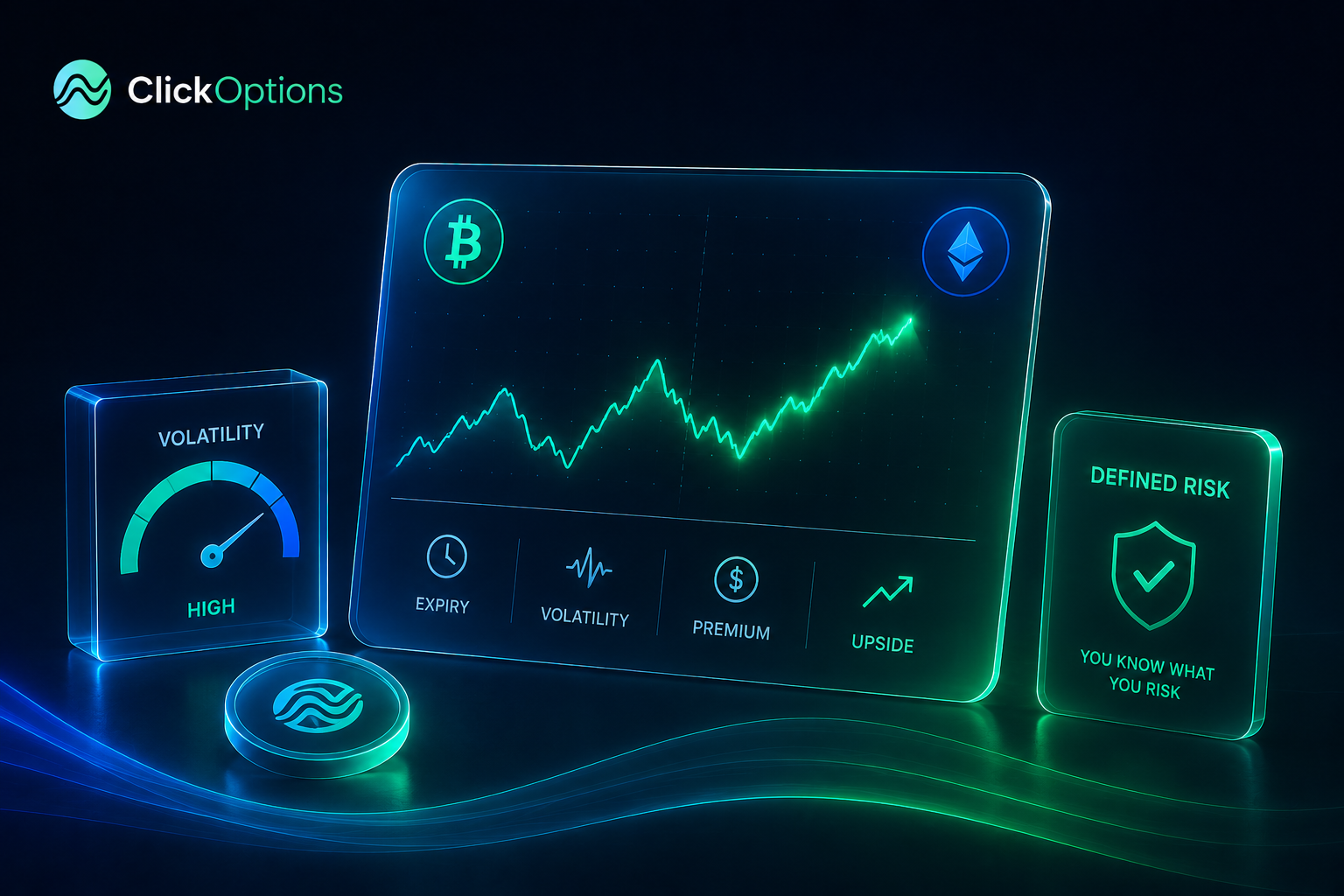
Crypto traders are watching volatility again.
After a quieter period, Bitcoin and Ethereum options activity has started getting more attention. Traders are not only asking whether prices will move up or down. They are also asking how much the market may move, how fast it may move, and whether the trade is worth the risk.
That is where options become important.
Options are not just about direction. They are also about time, pricing, volatility, expiry, and probability.
Why This Is Trending
Recent market reports show that crypto traders are positioning again through derivatives.
Coinbase’s August 2026 market positioning report noted that open interest rose across perpetuals, term futures, and options, even while spot and perpetual volumes declined. In simple terms, more risk was returning to trader balance sheets even though overall trading activity had not fully recovered.
Crypto-options research also reported that Bitcoin and Ethereum options recently repriced upside exposure, while front-end volatility moved sharply after late-August market activity.
That matters because volatility can change the price of an option before the market even makes a large move.
What Volatility Means
Volatility means movement.
When volatility is low, the market expects smaller moves. When volatility is high, the market expects bigger moves.
For crypto traders, this matters because Bitcoin and Ethereum can move quickly after macro news, ETF flow changes, liquidation events, regulatory updates, or sudden shifts in sentiment.
When expected movement rises, options can become more expensive. When expected movement falls, option prices can drop.
This is why traders need to look beyond direction.
A trader can be right that Bitcoin moves higher but still pay too much for the option.
Where ClickOptions Fits In
ClickOptions is built for traders who want a clearer way to trade crypto options and prediction options.
The platform focuses on defined conditions, visible risk, clear upside, and simple trade setup. ClickOptions describes itself as a crypto options venue built for better pricing, deeper markets, and clearer trading decisions.
Its pricing model also considers real trading behavior, including call and put demand, flow imbalances, and sentiment when adjusting premiums.
That is important in a volatility-driven market.
On ClickOptions, traders should not only ask, “Will Bitcoin or Ethereum move up?” They should also ask:
Is the price of this trade fair for the move I expect?
Why Clear Risk Matters
Volatility can create opportunity, but it can also create bad decisions.
When markets move fast, traders may rush into positions. They may chase upside. They may ignore expiry. They may focus on payout and forget the premium.
ClickOptions helps frame the trade around the condition, expiry, premium, and possible outcome. That can make the amount placed at risk easier to review before entering.
But clearer risk does not mean no risk.
ClickOptions warns that digital asset derivatives involve a high degree of risk and that options buyers may lose the entire premium paid if the option expires out of the money.
What Traders Should Check First
Before trading during volatile markets, traders should review:
- the asset being traded;
- the expiry time;
- the premium paid;
- the possible payout;
- the maximum loss;
- whether volatility is already priced in;
- whether the trade still makes sense if the move is smaller than expected.
This applies to crypto options and prediction options.
A simple-looking trade can still be expensive if many traders are already chasing the same outcome.
Final Thought
Crypto volatility is back in focus because traders are positioning for bigger moves again.
That creates opportunity, but it also makes pricing more important.
Platforms such as ClickOptions give traders a more structured way to trade crypto options and prediction options. But traders still need to understand the setup before entering.
The better question is not only, “Will the market move?”
It is:
“Is this trade priced fairly for the move I expect?”
This article is for educational purposes only and should not be considered financial advice.