
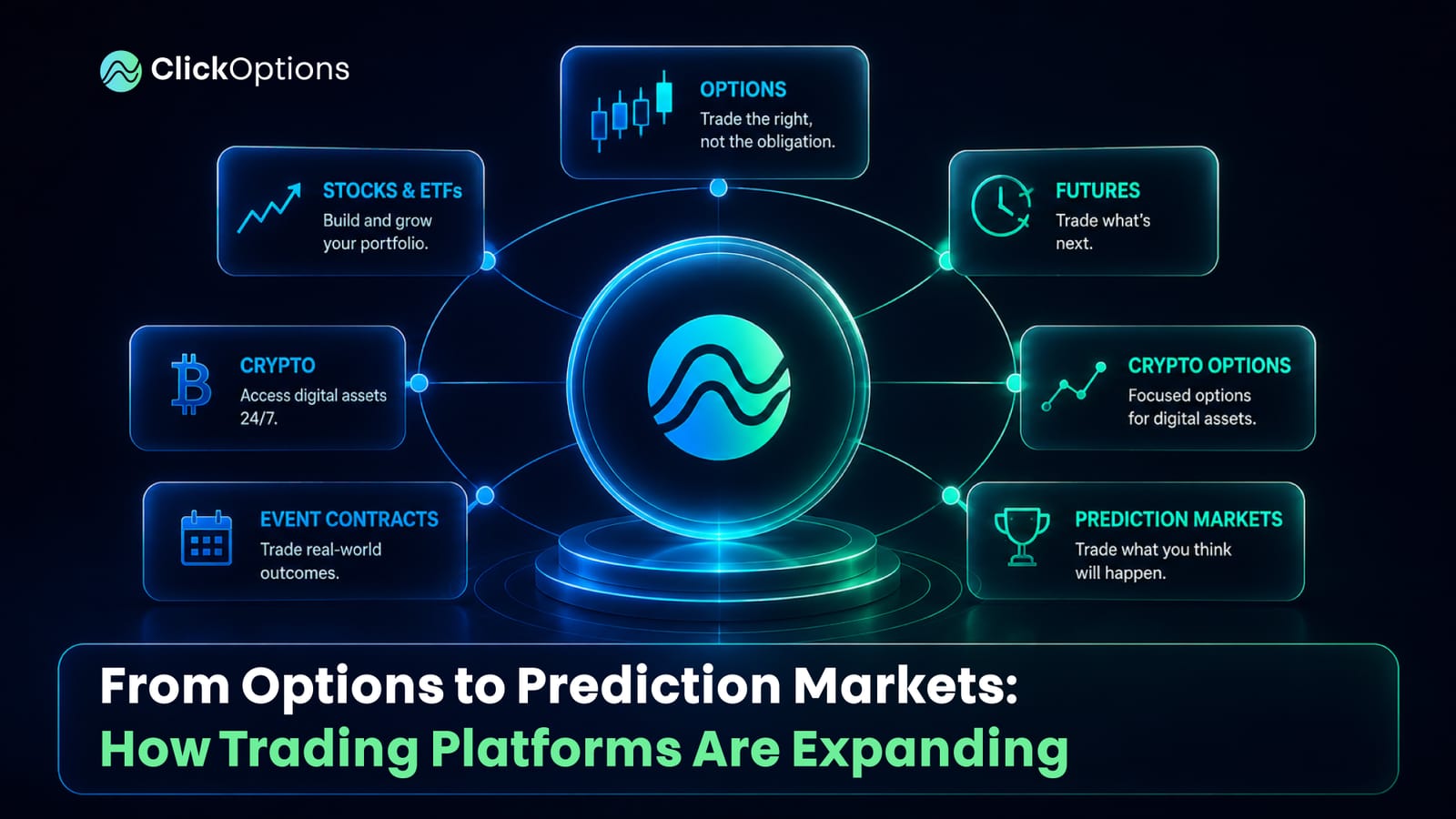
Trading platforms are no longer just places to buy stocks or place a call option.
Over the past few years, the retail trading landscape has become much broader. Many platforms now offer access to options, futures, crypto, event contracts, prediction markets, retirement accounts, cash products, and advanced market data. What used to be a simple brokerage account is increasingly becoming a full trading ecosystem.
Robinhood is one of the clearest examples of this shift. In April 2026, the company reported 225 million options contracts traded and 3.2 billion event contracts traded, showing how large demand has become for both traditional options and newer event-based products.
At the same time, specialist platforms such as ClickOptions are focusing on specific corners of the market, including crypto options. Instead of trying to offer every product to every trader, these platforms are building around more focused trading needs, such as digital-asset options, pricing visibility, liquidity, and contract structure.
The result is a trading market moving in two directions at once: large platforms are becoming broader, while niche platforms are becoming deeper.
Why Trading Platforms Are Expanding
Retail traders now expect more choice.
Stocks and ETFs are still important, but traders are also looking for ways to trade volatility, hedge positions, speculate on short-term price moves, and access markets that were once mostly used by professionals.
Options are a major part of that shift. Cboe reported that market-wide options average daily volume reached 68.6 million contracts in Q1 2026, compared with 60.4 million in Q1 2025.
That growth helps explain why platforms are investing heavily in derivatives. Options, futures, crypto options, and event contracts give users more ways to express a market view. For platforms, they can also increase activity, engagement, and product depth.
But broader access does not automatically mean better outcomes for traders. More products can also mean more confusion, more leverage, and more risk.
Options, Futures, Crypto Options, and Event Contracts: What’s the Difference?
These products may appear side by side inside the same trading app, but they are not the same.
Options give traders the right, but not the obligation, to buy or sell an asset at a set price before a certain date. They are commonly used for speculation, hedging, and income strategies.
Futures are contracts tied to the future price of an asset, index, commodity, or financial product. They can be useful for active traders, but they often involve leverage and can move quickly.
Crypto options work in a similar way to traditional options, but the underlying asset is usually a cryptocurrency such as Bitcoin or Ethereum. ClickOptions describes its platform as focused on crypto options trading, with contracts that are cash-settled in USDT and can be closed before expiry or held until maturity.
Event contracts are different. Instead of trading the price of a stock or crypto asset, traders take a position on whether a specific event will happen. Interactive Brokers describes ForecastEx contracts as exchange-listed yes-or-no contracts that typically settle at $0 or $1 based on the outcome.
This is where prediction markets enter the conversation. These markets allow users to trade around real-world outcomes, such as economic data, interest-rate decisions, political events, climate indicators, or other measurable events.
Robinhood and the Rise of Prediction Markets
Robinhood launched a prediction markets hub in 2025 through KalshiEX, a CFTC-regulated exchange. Reuters reported that the launch gave eligible users access to event contracts tied to outcomes such as Federal Reserve rate decisions and college basketball tournaments.
This move shows how retail platforms are changing. Robinhood is no longer competing only as a stock and options app. It is trying to become a broader financial platform where users can trade, invest, hold cash, use retirement products, and access new types of markets.
Interactive Brokers has also moved further into prediction-style products. Its ForecastTrader offering allows users to trade yes-or-no contracts on categories such as politics, economics, finance, and climate indicators where eligible.
This does not mean every trader should use these products. It means the definition of a “trading platform” is expanding.
Where ClickOptions Fits Into the Platform Trend
Not every platform is trying to become the same kind of financial super app.
Some platforms, like Robinhood, are broadening into stocks, options, crypto, retirement products, cash management, and event contracts. Others, like Interactive Brokers, serve more advanced traders with access to global markets, derivatives, and prediction-style products.
Then there are more focused platforms such as ClickOptions, which concentrates on crypto options rather than traditional stock or ETF options. This makes ClickOptions a useful example of how the options trading market is splitting into different categories.
A trader looking for stock options may compare platforms such as tastytrade, thinkorswim, Interactive Brokers, or Webull. A trader interested in crypto options may look at specialist platforms such as ClickOptions. The important point is that each platform can offer very different products, risks, contract rules, settlement methods, liquidity conditions, and eligibility requirements.
That is why traders should not judge platforms only by design, fees, or popularity. They should also understand what type of market the platform is built for.
Why This Matters for Retail Traders
More access can be useful, but it can also be dangerous when traders do not understand the product they are using.
A trader who understands stocks may not understand options. A trader who understands options may not understand futures. A trader who understands futures may still not understand event contracts or crypto options.
Each product has its own structure. Each product has its own risk profile.
Before using complex products, traders should understand:
- how the product gains or loses value;
- what happens at expiration or settlement;
- how much capital is at risk;
- whether leverage is involved;
- how fees affect returns;
- whether the product is being used for speculation, hedging, or short-term trading;
- whether the platform offers enough transparency around pricing and liquidity.
This is especially important as trading apps become easier to use. A clean interface can make complex products feel simple, but the risk underneath does not disappear.
The Regulatory Question
Prediction markets are also attracting more attention from regulators, lawmakers, and market observers.
Supporters argue that prediction markets can turn public expectations into useful market-based signals. Critics argue that some event contracts can look similar to gambling, especially when they involve politics, sports, or entertainment outcomes.
Reuters reported in May 2026 that prediction market platforms have seen a rise in suspicious trades as their popularity has grown, increasing concerns around insider trading and market oversight.
This matters because regulation can shape which products are available, who can trade them, and how platforms are allowed to present them.
For traders, the lesson is simple: when a product is new, fast-growing, or lightly understood, education matters even more.
Are Trading Apps Becoming Financial Super Apps?
In many cases, yes.
Trading platforms are becoming broader, more product-heavy, and more integrated. Stocks and ETFs may still be the foundation, but options, futures, crypto options, event contracts, prediction markets, retirement accounts, and cash products are increasingly being placed inside the same user experience.
At the same time, platforms such as ClickOptions show that there is also room for specialization. Not every trader wants one platform for everything. Some traders may prefer a focused venue built around a specific product category, such as crypto options.
This creates a more diverse trading environment. It also creates more responsibility for the trader.
The best approach is not to use every product just because it is available. The better approach is to understand each tool, compare platforms carefully, and decide whether the product fits a clear trading plan.
Final Thought
The next phase of retail trading will not be defined only by which app has the cleanest design or the lowest headline fees. It will be defined by which platforms give users broader access while helping them understand the risks behind that access.
Options, futures, crypto options, and prediction markets can all be powerful tools. But they are not shortcuts. They require education, discipline, and a clear understanding of how quickly complex products can move against a trader.
As platforms expand, traders need to become more selective. The question is no longer just, “Which platform can I trade on?”
The better question is, “Which platform actually matches the product, risk level, and strategy I understand?”
This article is for educational purposes only and should not be considered financial advice.