
Crypto traders now have more choices than simply buying Bitcoin or Ethereum.
Two of the most discussed products are perpetual futures, often called crypto perps, and crypto options. Both allow traders to take a view on price without directly owning the full underlying asset.
But they do not carry the same risks.
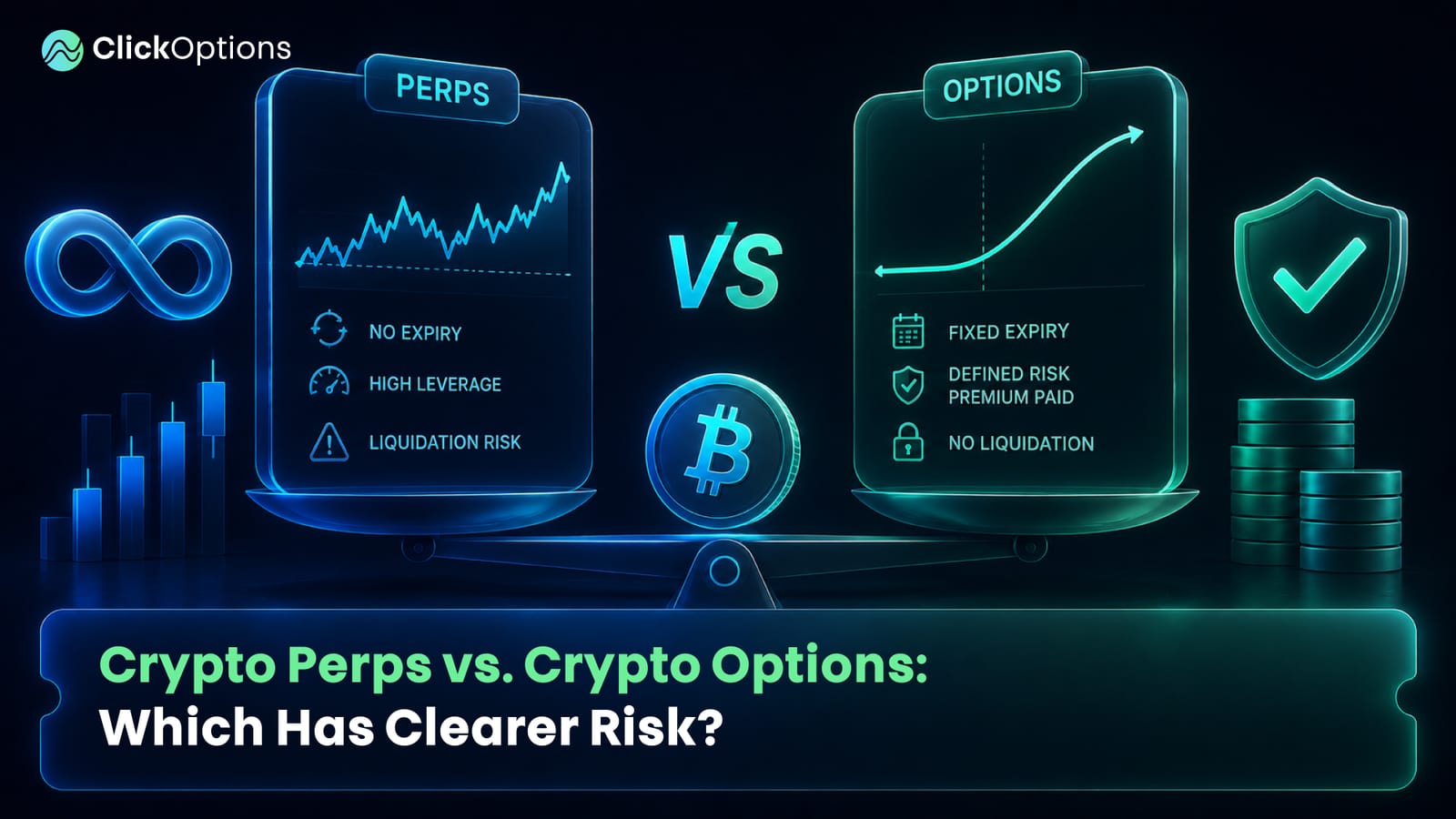
Perpetual futures can offer high leverage and have no fixed expiry date. Crypto options usually have an expiry and require the buyer to pay a premium before entering.
The difference may sound technical, but the basic question is simple:
How much can the trader lose, and how easy is that risk to understand before the trade begins?
Why Crypto Perps Are in the News
Crypto perpetual futures became a major U.S. market topic after the Commodity Futures Trading Commission approved a bitcoin perpetual futures contract for Kalshi in May 2026. The CFTC also established a path for other regulated exchanges to offer similar products.
The approval brought a product that was already popular on offshore crypto exchanges into the U.S. regulated market.
It also created controversy.
CME Group CEO Terry Duffy criticized the products for their high leverage, funding-rate costs, and automatic liquidation models. CME later filed a lawsuit challenging the CFTC’s approval process.
What Is a Crypto Perpetual Future?
A crypto perpetual future is a contract that follows the price of an underlying cryptocurrency.
Unlike a traditional futures contract, a perpetual future has no fixed expiry date. A trader can potentially keep the position open as long as the account continues to meet the platform’s margin requirements.
That does not mean the position can be held for free.
Perpetual futures commonly use funding payments to help keep the contract price close to the underlying crypto price. Depending on market conditions and the trader’s position, these payments may be received or paid at regular intervals.
Over time, funding costs can reduce returns.
How Leverage and Liquidation Work
Perpetual futures are often traded with leverage.
Leverage allows someone to control a larger position with a smaller amount of capital. For example, a trader using 10-times leverage can gain exposure to a position much larger than the cash committed as margin.
This can increase profits when the market moves in the trader’s favor.
It can also increase losses.
If the position moves too far in the wrong direction and the trader no longer has enough margin, the platform may close the position automatically. This is known as liquidation.
High leverage can make liquidation happen after a relatively small market move. Reuters reported that some newly approved perpetual products could offer leverage as high as 50-to-1, one reason critics raised concerns about their use by retail traders.
What Is a Crypto Option?
A crypto option gives the buyer the right, but not the obligation, to trade based on the price of an underlying cryptocurrency under specified conditions.
The buyer pays an upfront amount called the premium.
Unlike a perpetual future, an option normally has an expiry date. The expected move must happen within the contract’s time frame.
For a standard long option, the premium paid is generally the amount placed at risk. If the trade does not work, the option may expire without value.
This can make the possible loss easier to identify before entering.
But it does not make the trade safe.
Where ClickOptions Fits In
ClickOptions gives traders access to crypto options and prediction options built around defined market conditions.
Its crypto options are cash-settled in USDT and may be closed before expiry or held until maturity.
For traders comparing options with highly leveraged perpetual futures, the ClickOptions experience can make the amount placed at risk easier to see before the trade begins. The trader reviews the condition, expiry, premium, and potential outcome instead of managing a continuously leveraged position that may face liquidation.
ClickOptions also promotes the ability to trade crypto options without the automatic liquidation associated with leveraged perpetual positions.
However, clearer risk does not mean guaranteed profit. ClickOptions states that digital asset derivatives involve a high degree of risk, including the possibility of losing the capital placed at risk.
The Main Differences
A perpetual future has no fixed expiry. A crypto option normally does.
A perpetual future may involve ongoing funding payments. An option buyer pays a premium upfront.
A leveraged perpetual position may be liquidated if margin becomes insufficient. A standard long option can expire without value, but the buyer generally knows the premium placed at risk before entering.
Perpetual futures may be more flexible for traders who want to maintain ongoing exposure. Options may appeal to traders who want a defined time frame and a clearer maximum loss.
Neither product guarantees a profit.
Does Defined Risk Mean Lower Risk?
Not always.
Defined risk means the trader can identify the maximum possible loss before entering. It does not mean the probability of losing is low.
An option can expire worthless. A prediction option can settle against the trader. A series of small defined losses can still become a large total loss.
The premium may also be expensive relative to the probability of the expected outcome.
This is why traders should not focus only on the maximum payout. They should also consider:
- the premium being paid;
- the expiry date;
- the probability of the outcome;
- the liquidity of the contract;
- the settlement terms;
- the maximum possible loss.
ClickOptions can present these conditions in a more direct format, but the trader still needs to understand them before confirming the position.
Which Product Has Clearer Risk?
For many retail traders, a long crypto option may offer clearer risk because the premium is visible before the trade begins.
A perpetual future can be more difficult to manage because leverage, margin requirements, funding payments, and liquidation levels may change as the market moves.
That does not mean options are always the better product.
Perpetual futures and crypto options serve different purposes. The right choice depends on the trader’s strategy, knowledge, time frame, and ability to manage risk.
The most important step is understanding how the product can lose money.
Final Thought
Crypto perpetual futures and crypto options both provide ways to trade digital asset prices without simply buying and holding crypto.
Perpetual futures offer ongoing exposure, but leverage, funding fees, and liquidation can make losses difficult to manage.
Crypto options can make the amount placed at risk clearer. Platforms such as ClickOptions let traders use crypto options and prediction options with defined conditions and expiry rules. But those positions can still expire without value.
The better question is not, “Which product can make more money?”
It is:
“Which risk can I clearly understand and afford to take?”
This article is for educational purposes only and should not be considered financial advice.